



In the mortgage industry, document fraud costs lenders billions of dollars annually. While AI tools can detect altered documents, cross-referencing offers an even more powerful approach. This approach leverages a simple but profound truth: lying once is easy but maintaining that lie across dozens of interconnected documents is exponentially harder.
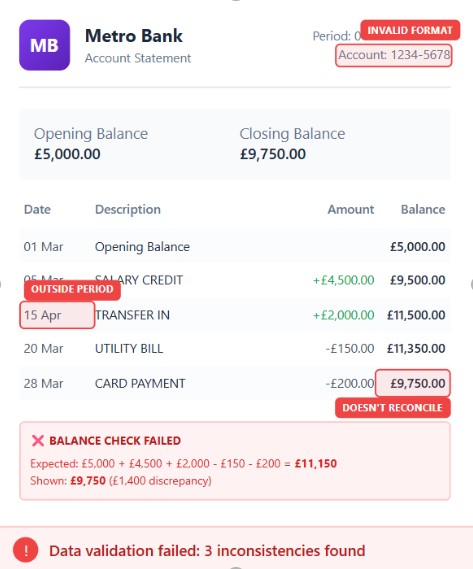
Understanding the Cross-Reference Advantage
Consider a fraudster who fabricates a pay stub showing $8,000 monthly income. That single falsification creates a cascade of requirements:
- Tax returns must show $96,000 in annual income
- Bank deposits of $8,000 must appear every two weeks
- Year-to-date figures must progress logically month over month
- Employer verification must withstand basic scrutiny
Miss just one detail and the entire fabrication collapses:
- A bank deposit showing $7,500 instead of $8,000
- A tax return reflecting last year’s income at $65,000
- An employer phone number that connects to a personal cell
This is why cross-referencing works. Fraud requires perfect consistency across dozens of interconnected data points, and consistency at scale is extraordinarily difficult to maintain.
The Triangle of Truth: Income, Assets, and Debts
At the heart of mortgage underwriting lies the “Mortgage Triangle” three interconnected pillars that must tell a consistent story:
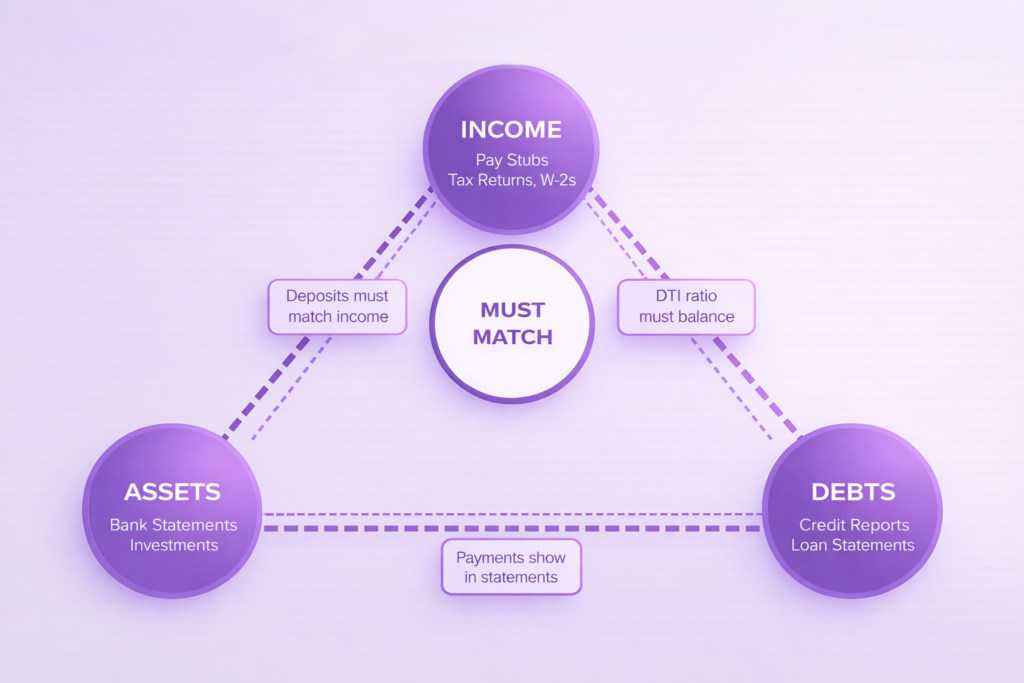
Income: Pay stubs, tax returns, W-2s, and employment verification letters
Assets: Bank statements, investment accounts, and down payment sources
Debts: Credit reports, existing loan statements, and monthly obligations
These three elements create a map of relationships that’s nearly impossible to fake consistently. Monthly debt payments visible on a credit report must appear as withdrawals in bank statements. The savings rate must make sense when income is reduced by documented expenses. The down payment must be traceable through asset documentation with a clear source of funds.
Key Cross-Reference Checks in Mortgage Processing
Income Verification Matrix
Perhaps, the most common area for fraud involves income inflation. Here’s how cross-referencing catches it:
Pay Stub to Tax Return Reconciliation: Compare the gross income on recent pay stubs with W-2 forms and tax returns from the previous year. Year-to-date figures on current pay stubs should align mathematically with historical annual income, accounting for any raises or job changes.
Bank Deposit Verification: Direct deposits in bank statements should match net pay amounts on pay stubs. The frequency, timing, and amounts should be consistent. Irregular deposits or round-number transfers shortly before application are red flags.
Employer Information Consistency: The employer’s name, address, and contact information must match across all documents. Phone numbers should connect to legitimate businesses, not personal cell phones or VoIP services.
Bank Statement Analysis
Bank statements are an excellent source for validation data when cross-referenced properly:
Balance Progression Logic: Account balances should follow logical patterns month-over-month. Sudden large deposits that don’t correspond to documented income sources warrant investigation. Equally suspicious are balances that don’t decline despite documented expenses.
Recurring Payment Patterns: Regular expenses like rent, utilities, car payments, and existing loan payments should appear consistently. These should also match amounts listed on the mortgage application and credit report.
Income Source Validation: Deposits should match documented income sources. Self-employed applicants claiming business income should show corresponding business account deposits, not personal transfers.
Tax Document Cross-Validation
Tax returns contain numerous internal consistency checks:
Income Aggregation: All W-2s, 1099s, and Schedule C income must add up to the Adjusted Gross Income reported. Employer Identification Numbers (EINs) should be verifiable against business databases.
Deduction Reasonableness: Tax deductions should align with income level and profession. Excessive business expenses that dramatically reduce taxable income require scrutiny, especially when those same expenses don’t appear in bank statements.
Multi-Year Consistency: Income should show logical progression or explicable variation across multiple tax years. Dramatic jumps in income during the application year without supporting documentation are suspicious.
Identity and Personal Information
Seemingly minor details reveal major inconsistencies:
Name Standardization: The applicant’s name should be spelled identically across all documents. Variations might indicate identity fraud or document manipulation.
Address History: Current and previous addresses should match across credit reports, tax returns, and identification documents. The timeline should be logical and verifiable.
Date of Birth and SSN: These critical identifiers must match perfectly across every single document. Even minor discrepancies are unacceptable.
Scale Your Mortgage Operations with Docspire
Contact us to see how it works
Implementing AI-Powered Cross-Reference Systems
Modern technology makes cross-referencing scalable and systematic rather than relying on manual review.
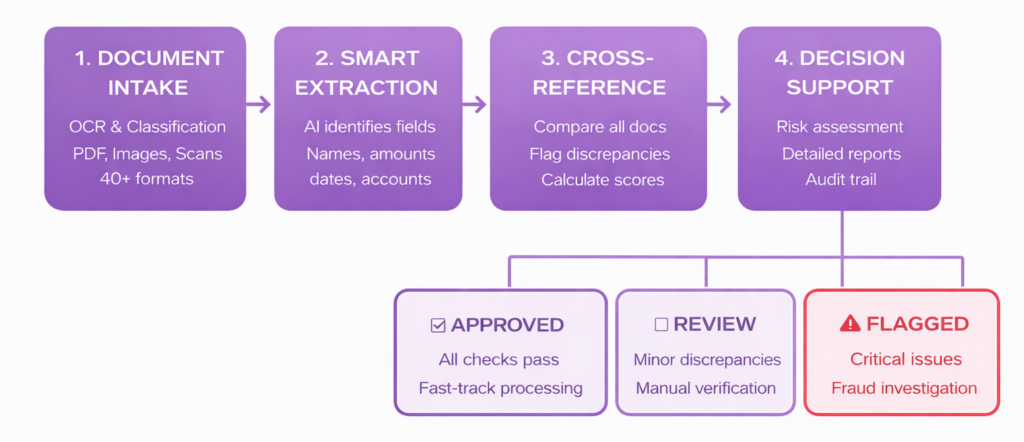
Data Extraction Pipeline
The first step is converting physical and digital documents into structured, analyzable data:
- Document Intake: Read all required mortgage applicant documents in any format via adaptive OCR. This includes, but not limited to, PDF bank statements, ID images, EDI feeds of credit reports, scanned pay stubs, and more.
- Classify: Automatically classify and label incoming loan documents as soon as they enter the system. The document list is expandable and works regardless of layout or format.
- Extract: Capture what you need from any document format with 99% accuracy. Income, accounts, addresses, employment details, banking transactions, and more. AI adapts to any layout without needing pre-defined rules.
- Data Normalization: Standardize formats for consistent comparison (dates, currency, addresses)
Building a Knowledge Graph
Once data is extracted, create a knowledge graph that maps relationships between entities:
- Connect all instances of the applicant’s name across documents
- Link employer information from different sources
- Associate account numbers with specific financial institutions
- Map income sources to corresponding deposits
This graph makes inconsistencies immediately visible. If John Smith’s employer is listed as “ABC Corporation” on a pay stub but “ABC Corp” on a tax return with a different address, the system flags this for review.
Automated Validation Rules
Implement both deterministic and probabilistic validation rules:
Hard Rules (Must Pass):
- Social Security Numbers must match exactly across all documents
- Mathematical calculations must be correct (tax computations, YTD totals)
- Dates must follow logical sequences (can’t have employment start after pay stub date)
Soft Rules (Generate Alerts):
- Income variance across sources exceeds 5%
- Address spellings differ slightly
- Employer phone numbers aren’t listed in business directories
- Round numbers appear frequently (suggesting manual fabrication)
Anomaly Detection Models
Machine learning excels at identifying statistical outliers:
Pattern Recognition: Train models on thousands of legitimate applications to learn what “normal” looks like. Flag applications that deviate significantly from these learned patterns.
Ratio Analysis: Debt-to-income ratios, loan-to-value ratios, and savings rates should fall within expected ranges for the applicant’s profile.
Temporal Consistency: Document creation dates, account opening dates, and transaction timestamps should make logical sense within the application timeline.
Common Fraud Patterns Detected by Cross-Referencing
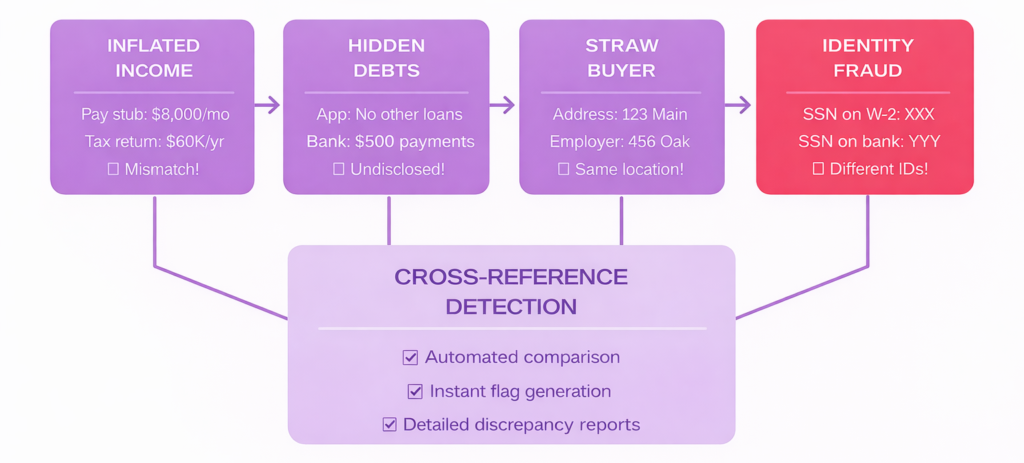
The Inflated Income Scheme
An applicant submits pay stubs showing an $8,000 monthly salary but:
- Tax returns from the previous year show annual income of only $60,000 (not $96,000)
- Bank deposits average $4,500 per month, not $8,000
- Year-to-date figures on current pay stubs don’t match expected progression
Detection: Income cross-reference rules immediately flag the 60%+ discrepancy between claimed current income and both historical and deposited amounts.
The Sudden Wealth Injection
Bank statements show modest balances for months, then a sudden $50,000 deposit two weeks before application:
- No corresponding documentation for the deposit source
- Previous month’s statements show no similar transactions
- Tax returns don’t reflect income that would support such savings
Detection: Temporal anomaly detection flags the unusual deposit pattern. Cross-referencing with income documentation reveals the deposit exceeds reasonable savings capacity.
The Hidden Liability
An applicant shows excellent debt-to-income ratio, but:
- Credit report reveals a $600 monthly car payment not listed on application
- Bank statements show regular $600 transfers labeled “auto loan”
- Total monthly obligations are actually above acceptable thresholds
Detection: Cross-referencing credit reports with bank statements and application disclosures reveals the undisclosed obligation.
The Fabricated Employment
Employment verification letter shows applicant works at a company, but:
- Company phone number is a personal cell phone
- No payroll deposits appear from that company in bank statements
- LinkedIn profile shows different employment
- Tax returns show no W-2 from that employer
Detection: Multi-source employment verification reveals inconsistencies between stated employment and actual income sources.
Scoring and Risk Assessment
Not all discrepancies are equal. Implement a weighted scoring system:
Critical (Auto-Reject):
- Different Social Security Numbers across documents
- Evidence of document tampering (metadata inconsistencies, impossible dates)
- Income sources completely fabricated with no supporting evidence
High Risk (Mandatory Manual Review):
- Income discrepancies exceeding 10%
- Unexplained large asset deposits
- Multiple address or employer inconsistencies
- Missing expected documentation
Medium Risk (Flagged for Review):
- Minor name spelling variations
- Small calculation errors in tax documents
- Income variance of 5-10%
- Single missing or unclear document
Low Risk (Automated Notes):
- Formatting differences across documents
- Slight address abbreviation variations
- Documents from different time periods showing expected changes
Compliance and Audit Considerations
Cross-referencing systems must be built with regulatory compliance at their core. Four key pillars support this foundation.
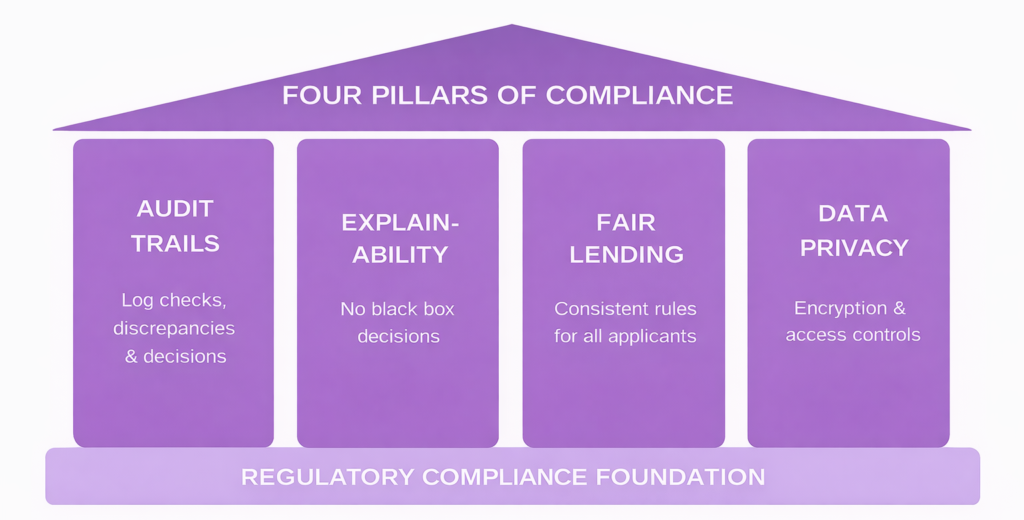
Comprehensive audit trails must log every check, discrepancy, and decision. These records are essential for regulatory reviews, applicant appeals, and identifying patterns over time.
Explainability matters because applicants have the right to know why they were declined. Your system should clearly document which cross-reference checks failed and why. For example, if a pay stub income doesn’t match the tax return, the system should flag the specific discrepancy. Regulators and consumers reject “black box” decisions that offer no clear reasoning.
Fair lending requires consistent validation of rules regardless of demographics. The same tolerance thresholds and flagging criteria must apply to every applicant. Regularly monitor whether discrepancy flags disproportionately affect protected classes like race, national origin, or familial status.
Data privacy demands robust security. Cross-referencing systems aggregate sensitive financial and personal information from multiple sources. Use encryption, access controls, and retention policies to protect this data throughout the validation process and comply with regulations like the Gramm-Leach-Bliley Act.
Measuring Success
Track these five key performance indicators to evaluate system effectiveness:
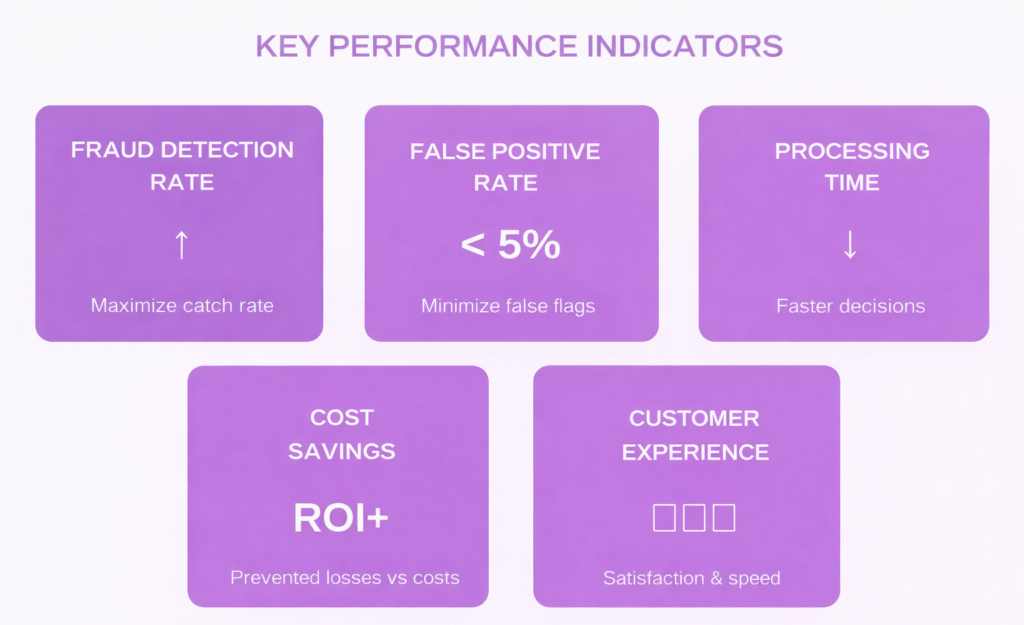
Fraud detection rate measures fraudulent applications caught before closing. Compare pre- and post-implementation losses to quantify improvement.
False positive rate measures how often legitimate applications are incorrectly flagged. We target under 5% to limit unnecessary manual reviews. In fraud detection, false negatives carry greater risk, so the system prioritizes high recall, aiming to catch over 98% of fraudulent cases, even if that means accepting a small increase in false positives. A system that catches fraud but delays a large share of legitimate applications creates operational friction rather than value.
Processing time should decrease despite additional checks. Automation eliminates manual comparison and routes clean applications faster.
Cost savings calculate prevented losses minus implementation and operation costs. Factor in reduced regulatory penalties for improved compliance.
Customer experience ensures fraud prevention doesn’t hurt satisfaction. Monitor time-to-decision for legitimate borrowers to identify friction points.
The Future of Cross-Reference Validation
Emerging technologies will make cross-referencing even more powerful. Four key innovations are reshaping the landscape.
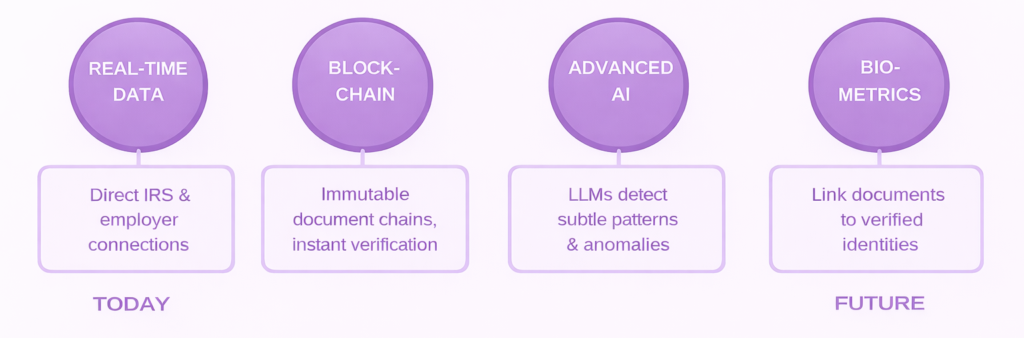
Real-time data integration will connect directly to IRS databases, employers, and financial institutions. Verifying income against authoritative sources makes document fabrication pointless.
Blockchain verification creates immutable document chains. Documents cryptographically linked to their sources make tampering impossible and verification instant.
Advanced AI models understand document context and detect subtle inconsistencies that rule-based systems miss. They adapt quickly to new fraud patterns.
Biometric integration links documents to verified identities. When applications tie to confirmed face or fingerprint data, identity theft becomes far more difficult.
Conclusion: The Power of Consistency
In mortgage lending, the old adage “trust, but verify” has evolved into “verify everything, against everything else.” Cross-referencing and data consistency validation transform document review from a checklist exercise into a sophisticated fraud detection system.
The beauty of this approach is its inherent elegance: fraudsters must not only create convincing individual documents but maintain perfect consistency across a complex web of interconnected data points. One small oversight, such as a bank deposit that doesn’t match a pay stub, or a tax deduction that doesn’t appear in bank statements, or an employer phone number that’s actually a personal cell, and the entire fabrication collapses.
For mortgage lenders, implementing robust cross-referencing systems isn’t just about preventing fraud; it’s about building confidence in every approved loan. When every data point has been validated against multiple independent sources, underwriters can approve applications with certainty, regulators can trust the diligence process, and the entire mortgage ecosystem becomes more stable and secure.
The technology exists with proven methodologies. The only question is: are you ready to make ‘data consistency’ your most powerful fraud detection tool?
Implementing Cross-Reference Validation with Docspire
For lenders who want powerful cross-referencing without building from scratch, Docspire offers a ready-to-deploy solution for mortgage document processing. The platform convers the most common fraud patterns out of the box such as built-in checks for income verification, bank statement analysis, tax reconciliation, and identity consistency.
What sets Docspire apart is flexibility: add unlimited custom checks for non-traditional income, regional compliance, or proprietary risk criteria. Deploy fast, then learn as fraud patterns change.
See how Docspire can deliver clean, validated, and fraud-checked data into your LOS.Book a demo today
Stop losing money to matching errors – See how Docspire can help →
Start your 14-day free trial!