



For most Accounts Payable teams, the 1099 season still feels like a controlled emergency.
Spreadsheets are pulled. Vendor files are audited manually. Missing W-9s suddenly surface. Payment totals are recalculated under deadline pressure. Corrections trigger amended filings. Finance leaders brace for penalty exposure.
But 1099 compliance is not a January event.
It is a year-round vendor data governance process that requires continuous document validation, cumulative payment intelligence, and structured reporting discipline.
Modern finance organizations are replacing reactive reconciliation with automated vendor flagging, real-time payment aggregation, and AI-driven document intelligence that keeps compliance continuously controlled.
Why Traditional 1099 Vendor Management Breaks Down
1099 compliance is the process of collecting, validating, and reporting vendor tax information across the entire payment lifecycle. It fails in most organizations because vendor data is fragmented, payment tracking is not consolidated in real time, and errors are only discovered during year-end filing instead of at document intake.
1099 compliance spans the entire vendor lifecycle:
- W-9 or W-8 collection during onboarding
- Invoice and payment processing throughout the year
- Cumulative threshold monitoring
- 1099-NEC or 1099-MISC issuance
- Backup withholding enforcement when required
- Corrections triggered by IRS notices
Yet most organizations manage this lifecycle across disconnected systems, manual workflows, and spreadsheet reconciliations.
The result is delayed error detection and concentrated year-end risk.
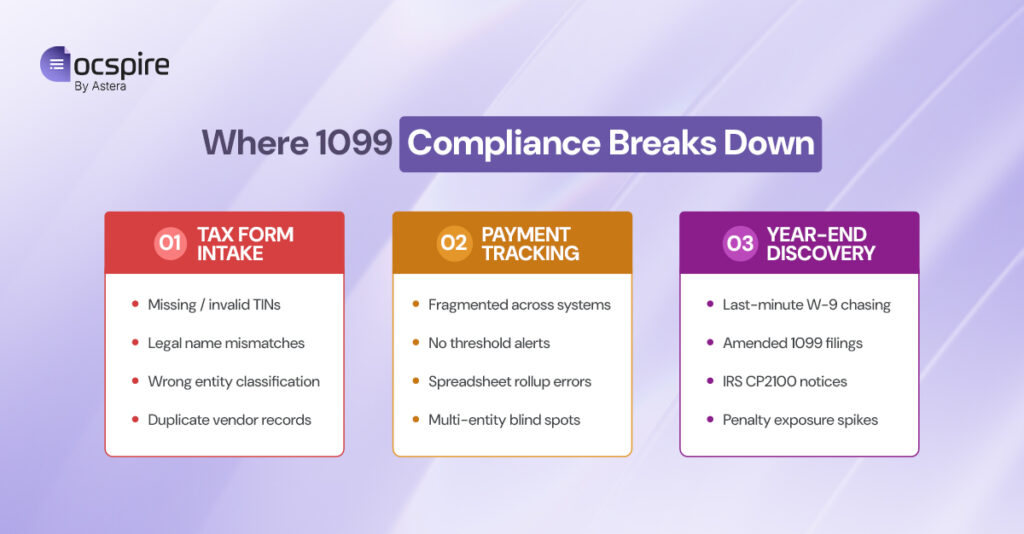
Where Failures Typically Occur
-
Manual Tax Form Intake
W-9s and W-8s arrive via:
- Email attachments
- Vendor portals
- Scanned documents
- Paper submissions
Common data risks include:
- Missing or invalid TINs
- Legal name mismatches
- Incorrect entity classifications
- Outdated addresses
- Illegible handwriting
- Duplicate vendor records
Without structured extraction and real-time validation at intake, these issues remain hidden until filing season.
-
Fragmented Payment Tracking
1099 eligibility is determined by cumulative annual payments.
However, payment data often lives across:
- AP systems
- Corporate card platforms
- Expense management tools
- Procurement systems
- Multiple entities or subsidiaries
When totals are not consolidated dynamically, vendors can exceed reporting thresholds without detection. Manual spreadsheet rollups increase the risk of both underreporting and overreporting.
-
Year-End Discovery of Errors
By January, teams are forced to:
- Chase vendors for missing W-9s
- Correct TIN mismatches
- Recalculate cumulative payments
- File amended 1099s
- Respond to IRS CP2100 notices
Compliance becomes reactive reconstruction instead of controlled governance.
The Financial Cost of Reactive Compliance
IRS penalties escalate based on timing and severity:
- $60 per form for early corrections
- $340 per form after August 1
- $660 per form for intentional disregard, with no annual cap
When errors are identified months after filing, financial exposure increases rapidly.
The pattern is consistent: The later errors are detected, the more expensive they become.
Regulatory Changes Are Already Here
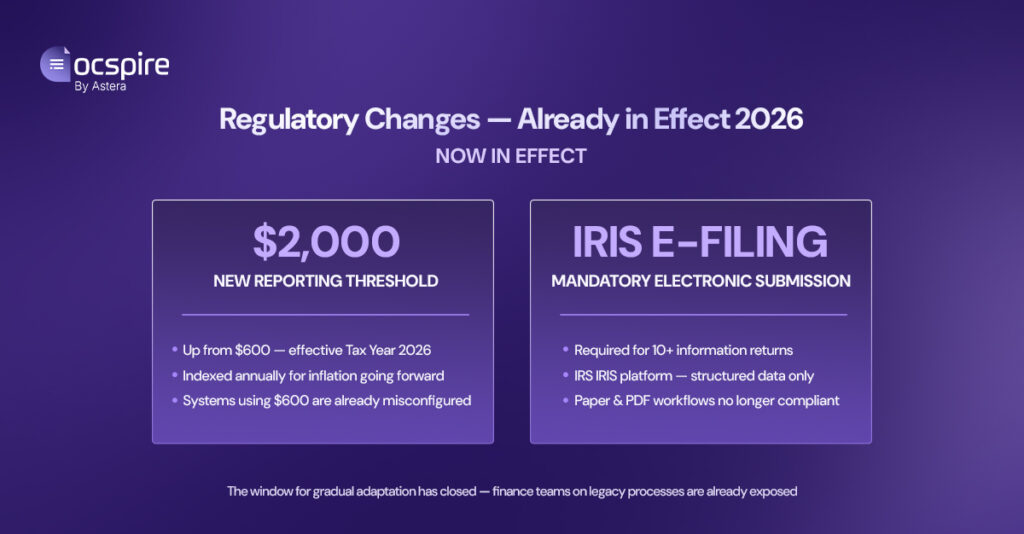
Two major compliance changes are now in effect for Tax Year 2026
The reporting landscape has tightened, and the new rules are in effect now.
Reporting Threshold
The IRS has raised the 1099 reporting threshold from $600 to $2,000 beginning Tax Year 2026, with annual inflation indexing going forward. Organizations still operating on $600-based rules in their AP systems are already misconfigured for the current filing year.
Mandatory Electronic Filing Through IRS IRIS
Organizations filing 10 or more aggregate information returns are now required to submit electronically through the IRS IRIS platform. Paper-based and manual PDF workflows are no longer a compliant option at scale.
The window for gradual adaptation has closed. Finance teams operating on legacy processes are already exposed.
You can automate 1099 compliance by extracting tax data at intake, validating TIN and vendor details in real time, aggregating payments across systems, and continuously monitoring thresholds. This eliminates manual reconciliation and ensures that 1099 reporting is accurate, audit-ready, and aligned with IRS requirements throughout the year.
What Modern 1099 Vendor Management Looks Like
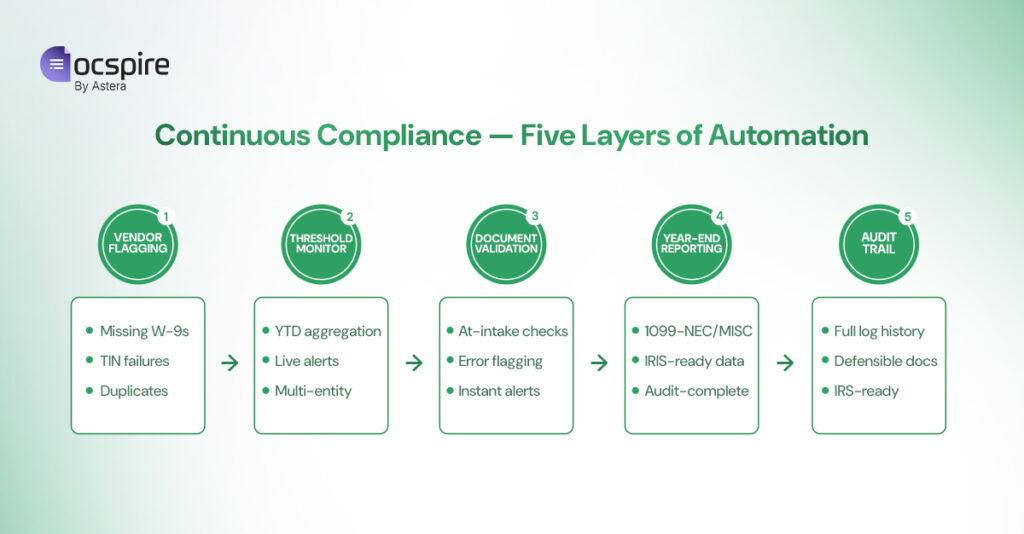
Automation transforms compliance from a year-end scramble into continuous financial control.
-
Automated Vendor Flagging
Vendors are automatically flagged when:
- A required W-9 is missing
- A TIN format fails validation
- Legal name and TIN do not align
- Entity classification conflicts with payment type
- Duplicate records are detected
- Payments approach or exceed reporting thresholds
Instead of auditing every vendor manually, teams focus exclusively on exceptions.
-
Real-Time Threshold Monitoring
Year-to-date payment totals are aggregated automatically across all systems and entities.
As vendors approach reporting thresholds:
- Alerts trigger
- Vendor status updates dynamically
- 1099 eligibility is calculated in real time
No spreadsheet reconciliation. No last-minute recalculations.
-
Continuous Document Validation
Every tax form and invoice is processed at intake using structured extraction and validation logic.
Errors are identified immediately when documents are received, not months later during filing.
Early detection materially reduces penalty exposure.
-
Automated Year-End Reporting
By filing season:
- 1099-NEC and 1099-MISC data is already structured
- Vendor classifications are validated
- Threshold determinations are finalized
- Audit documentation is complete
- Electronic filing datasets are IRIS-ready
Year-end becomes confirmation rather than reconstruction.
How Docspire Enables Continuous 1099 Control
Docspire is an AI-powered document intelligence platform built for high-volume financial workflows.
It modernizes 1099 vendor management across the full lifecycle.
Stop Discovering 1099 Errors at Year-End
See how it works
Intelligent Tax Form Extraction
Docspire extracts structured data from:
- W-9
- W-8 series forms
- 1099-related documentation
Captured fields include:
- Legal name
- Business name
- TIN
- Entity classification
- Address
It processes PDFs, scans, images, and multilingual submissions with 99.5% field-level accuracy.
Extracted data flows directly into vendor master systems where validation rules are enforced automatically.
Invoice Capture & Payment Consolidation
Docspire processes invoices from:
- Email inboxes
- PDF attachments
- Scanned uploads
- EDI feeds
- Vendor portals
Vendor identifiers and payment values are captured and aggregated into real-time dashboards that monitor 1099 eligibility continuously.
Exception-Based Workflow Automation
Configurable business rules enforce:
- TIN validation
- Legal name matching
- Duplicate detection
- Entity classification checks
- 1099 categorization
- Threshold monitoring
Only anomalies require human review. The rest flows automatically.
Built-In Audit Trail & Defensibility
Every action is logged:
- Document receipt timestamp
- Extraction output
- Validation results
- User overrides
- Corrections
This creates defensible documentation and audit readiness at all times.
Operational Impact
Organizations implementing automated 1099 vendor management typically experience:
- Reduced penalty exposure
- Fewer amended filings
- Faster year-end close
- Improved vendor master data integrity
- Increased AP scalability without proportional headcount growth
- Reduced IRS notice volume
Most importantly, compliance shifts from reactive correction to proactive governance.
The Strategic Bottom Line
1099 compliance is no longer a clerical reporting task.
It is a vendor data governance function that requires:
- Automated vendor flagging
- Real-time threshold tracking
- Continuous validation
- Structured electronic reporting readiness
With regulatory requirements tightening and penalties escalating, spreadsheet-driven workflows introduce unnecessary financial and operational risk.
Automate Your Doc Processing Workflows with Docspire
Contact us to see how it worksAI-powered document intelligence transforms 1099 vendor management into a controlled, automated, audit-ready process from day one.
Docspire offers a 14-day free trial with implementation in under five minutes and no template configuration required.
Because 1099 season should not feel like crisis management.
It should feel automatic.