


TL;DR: Elite AP teams now achieve 70-90% touchless invoice processing, compared to 20-35% for manual-heavy operations. Organizations implementing end-to-end intelligent accounts payable (AP) automation see payback within 6-12 months through faster cycle times, higher accuracy, and reduced operating costs. This report shows you how to close the gap using modern AP automation software.
Accounts Payable teams face mounting pressure in 2026. Invoice volumes continue to rise while headcount remains flat. Expectations for speed, accuracy, and control are higher than ever. Manual processes introduce delays, increase error rates, strain vendor relationships, and create audit risk.
AP automation is no longer about incremental efficiency gains. It has become a foundational requirement for scalable, resilient finance operations and modern finance digital transformation.
This report shows how AP automation works today: what works, what doesn’t, and how top teams get results. It’s built for finance leaders who want practical, real-world insights into intelligent invoice processing, ERP-integrated automation, and touchless accounts payable workflows.
The Current State
Most organizations operate in a hybrid state: no longer fully manual, but not yet fully automated. Manual-heavy environments typically achieve touchless processing rates of 20–35%. Rule-based automation improves that to 45–55%, but often breaks down when invoice variability increases.
In contrast, teams using intelligent automation where invoices are understood rather than simply read consistently reach 70–90% touchless processing while maintaining strong controls and visibility.
Touchless invoice processing refers to invoices that move from receipt to ERP posting without manual data entry or correction.
What’s Driving Change
Several forces are accelerating AP automation adoption in 2026.
Invoice volumes are growing without corresponding staff increases. Payment cycle expectations are tightening as vendors demand faster settlement.
Manual approval routing remains the single largest source of delay in invoice processing cycle time. At the same time, finance leaders face increased pressure for clean financial data, audit-ready documentation, and real-time ERP integration.
High-performing AP teams focus on reducing unnecessary manual touches rather than eliminating human oversight entirely. Automation handles routine invoice processing at scale, while people concentrate on exceptions, decision-making, vendor relationship management, and continuous improvement.
The result is faster cycle times, higher first-pass accuracy, reduced operating costs, and improved vendor relationships.
Where AP Teams Stand in 2026
Most AP teams are not fully manual. But very few are fully automated. In practice, we see three common setups:
| Model | Characteristics | Touchless Rate |
| Manual-Heavy AP | Invoices arrive by email or scan. Basic OCR extracts data. AP teams review most fields, fix errors, chase approvals manually. | 20-35% |
| Rule-Based Automation | Standard invoices follow predefined rules. Anything outside the norm becomes an exception and drops back into manual processing queues. | 45-55% |
| Intelligent Automation | Invoices are understood, not just read. AI handles variability. Data flows into ERP with minimal human touch. Teams focus on exceptions and decision-making. | 70-90% |
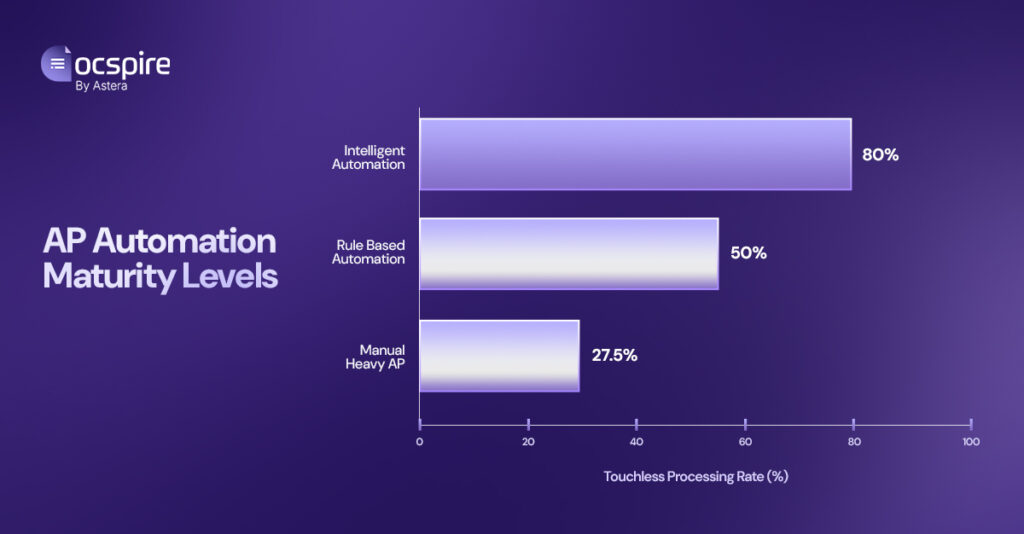
Most organizations sit somewhere between rule-based and intelligent automation. AI-powered AP automation handles variability and data flows into ERP systems with minimal human touch. The goal in 2026 is clear: reduce manual work without losing control or visibility.
What Is Driving AP Automation Right Now
Understanding current pressure points helps explain why AP automation has shifted from “nice to have” to “business critical” in 2026.
Volume without headcount growth
Invoice volumes keep increasing. Finance teams are expected to handle more work with the same or fewer people. According to industry benchmarks, 73% of organizations report invoice volumes grew 15-20% year-over-year, while 68% maintained flat or reduced AP headcount.
Automation is no longer optional. It is the only way to scale operations without proportional headcount increases.
Pressure to move faster
Late approvals delay payments. Delayed payments damage vendor relationships and eliminate early payment discount opportunities. Top vendors increasingly expect payment within 15-30 days, not 45-60.
Manual approval routing is where most processing time gets lost. Emails sit in inboxes. Approvers don’t know invoices are waiting. Escalation happens ad-hoc.
Intelligent approval routing
Automated approval workflows route invoices based on:
- Amount thresholds (under $500 auto-approve, $500-$5K department head, $5K+ CFO)
- Department or cost center ownership
- PO matching status (3-way matched invoices auto-approve)
- Vendor category or risk profile
Smart routing includes automatic escalation after 48-72 hours, mobile approval capabilities for managers, delegation rules during employee absence, and complete approval history and audit trails.
Teams implementing automated approval workflows reduce cycle time from 8-12 days to 1-3 days on average, with critical invoices approved same-day.
Accuracy and audit pressure
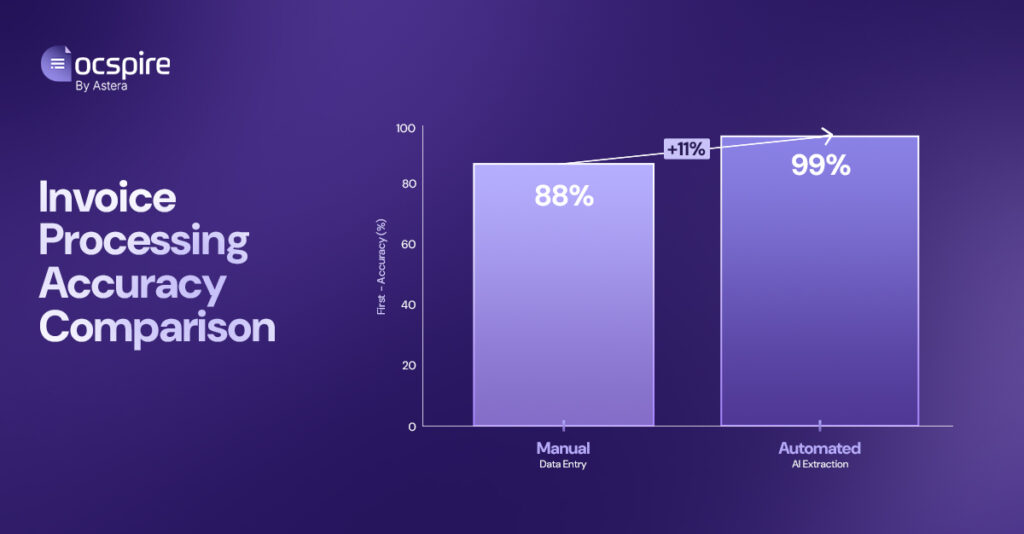
Errors lead to rework, duplicate payments, and audit findings. Manual data entry accuracy typically ranges from 85-92%, meaning 8-15% of invoices contain at least one error requiring correction.
Finance leaders want clean data and clear audit trails. Intelligent AP automation systems achieve 98-99% first-pass accuracy and automatically create comprehensive audit logs that support financial audits and internal controls.
ERP dependency
AP operations live inside the ERP system. If automation does not integrate cleanly with SAP, Oracle NetSuite, Microsoft Dynamics, or other core finance systems, teams abandon it and revert to manual workarounds.
Seamless ERP integration is not a feature. It is a requirement for successful AP automation deployment and long-term adoption.
Duplicate Payment Prevention
Duplicate payments represent 0.5-2% of total AP spend in manual environments. It makes a $500K-$2M annual loss for organizations processing $100M in payables.
Modern AP automation systems detect duplicates through invoice number matching across vendors, amount and date proximity analysis, vendor and PO combination checks, and fuzzy matching for similar but not identical invoices.
Automated duplicate detection eliminates this preventable loss while reducing audit burden and strengthening financial controls.
Key AP Automation Trends in 2026
AI that understands documents
Teams are moving away from rigid template-based OCR systems. Modern AI-powered platforms handle different layouts, vendor formats, and document types without constant template maintenance or manual configuration.
The technology shift is significant. AI models trained on millions of invoices can extract and validate data from previously unseen formats with minimal setup. This eliminates the template management burden that plagued earlier OCR implementations.
Fewer touches, not zero oversight
The goal is not full autonomy. It is reducing unnecessary manual reviews while maintaining appropriate controls. High-performing teams aim for 70-90% touchless processing, with human oversight focused on genuine exceptions.
Exceptions get the attention
Instead of reviewing every invoice, AP teams focus exclusively on items requiring decisions. Price mismatches. Missing purchase orders. Potential duplicates. New vendor validation.
Exception-based workflows free AP professionals to do higher-value work: vendor relationship management, process improvement, and strategic analysis.
Real time ERP sync
Posting delays create confusion and reduce visibility. Modern AP automation systems maintain tight API-based integration with ERP systems, ensuring real-time data accuracy, liability visibility, and continuous synchronization across finance operations.
Batch processing is being replaced by continuous synchronization. This enables faster month-end close, better cash flow visibility, and more confident decision-making.
Compliance built into the flow
Approval workflows, permission structures, and audit logs are embedded into the automation process, not added as afterthoughts. This ensures compliance requirements are met automatically without creating additional administrative burden.
What Still Breaks AP Automation
Even in 2026, automation is not friction-free. Understanding common failure points helps teams plan more effectively and set realistic expectations.
Invoice variability
Vendors send invoices in every imaginable format. PDFs, scanned images, emails with embedded tables, Excel attachments. Systems that rely on rigid templates or inflexible rules struggle with this variability. Modern AI-based systems handle this better, but even they require careful tuning for unusual document types.
Complex exceptions
Partial receipts, contract billing, usage-based charges, and multi-line item reconciliation still require intelligent handling. These scenarios represent 15-25% of total invoice volume but often consume 50-60% of AP team time.
Change resistance
AP teams worry about disruption, job security, and loss of control. Without proper training, clear communication, and demonstrated early wins, adoption stalls. Successful implementations treat change management as seriously as technical deployment.
Weak integrations
If data does not flow cleanly into the ERP, teams revert to spreadsheets, manual uploads, or workarounds. Integration quality makes or breaks AP automation success. Teams should evaluate integration depth during vendor selection, not after purchase.
What High-Performing AP Teams Do Differently
Teams achieving measurable results share common operational habits and strategic approaches. These patterns emerge consistently across industries and organization sizes.
They Define Success Clearly
High-performing teams track specific, measurable KPIs:
- Cost per invoice processed
- Invoice processing cycle time (receipt to posting)
- Touchless processing rate
- First-pass accuracy rate
- Exception resolution time
- Early payment discount capture rate
They establish baselines before implementation and track improvement monthly. Vague goals produce vague results.
They Automate the Full Flow
Automation is not just data extraction. It encompasses:
- Invoice intake (email, portal, EDI)
- Data extraction and validation
- Approval routing and workflow
- ERP posting and reconciliation
- Document archiving and retrieval
Partial automation creates new manual handoffs. End-to-end automation delivers exponentially better results.
They Design for Exceptions, Not Perfection
Automation handles the routine. People handle judgment calls. High-performing teams build clear exception workflows:
- Exception categorization (PO mismatch, duplicate risk, new vendor, pricing variance)
- Clear ownership and escalation paths
- Response time SLAs for each exception type
- Regular exception analysis to identify systemic issues
Chasing 100% touchless processing wastes resources. Optimizing exception handling delivers better ROI.
They Treat Automation as a System, Not a Tool
Successful implementations require alignment across:
- AP operations (day-to-day execution)
- IT (integration, security, infrastructure)
- Finance leadership (strategy, budget, change management)
- Procurement (vendor enablement, PO discipline)
Treating AP automation as an isolated AP project guarantees suboptimal results. Cross-functional collaboration determines success.
AP Automation as Part of Finance Operations
AP does not exist in isolation. It connects to every aspect of finance operations.
Clean invoice data feeds cash flow planning. Vendor payment history supports risk assessments. Faster AP processing accelerates month-end close. Reduced processing costs improve overall finance efficiency metrics.
In 2026, strong AP automation supports:
- Faster month-end close (reduced AP bottlenecks)
- Better cash visibility (real-time liability tracking)
- Fewer vendor disputes (accurate, timely payments)
- More confident audits (complete documentation, clear controls)
- Strategic vendor relationships (early payment programs, volume discounts)
When AP automation works well, the entire finance function benefits. When it breaks, finance operations suffer.
Calculating AP Automation ROI
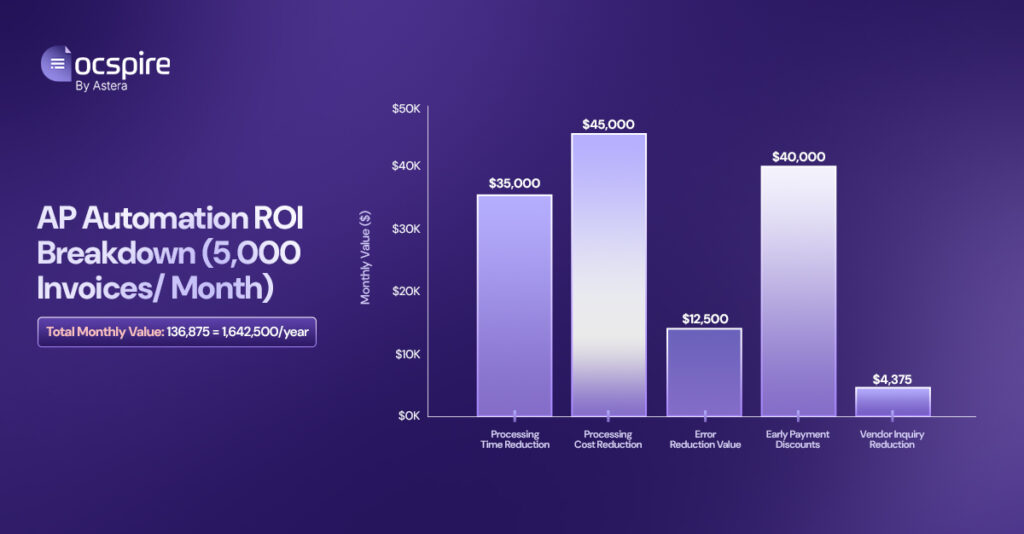
Understanding return on investment helps secure budget approval and measure success. Here is a practical framework for a team processing 5,000 invoices per month:
| Component | Calculation | Monthly Value |
| Processing Time Reduction | (15 min – 3 min) × 5,000 × ($35/hr ÷ 60) | $35,000 |
| Processing Cost Reduction | ($12 – $3) × 5,000 | $45,000 |
| Error Reduction Value | 10% × 5,000 × $25 | $12,500 |
| Early Payment Discounts | $2M × 2% | $40,000 |
| Vendor Inquiry Reduction | 500 × 15 min × ($35/hr ÷ 60) | $4,375 |
| Total Monthly Value | Sum of all components | $136,875 |
Total Annual Value: $1,644,500
Typical payback period: 6-12 months for mid-market organizations, 3-6 months for enterprises processing 10,000+ invoices monthly.
What Comes Next
Over the next few years, AP automation will focus less on data extraction and more on decision support and predictive analytics.
Systems will flag potential risks earlier. Duplicate detection will become more sophisticated. Exception resolution will accelerate through better vendor data enrichment and historical pattern analysis. AP teams will spend more time reviewing outcomes and strategic insights, less time correcting data fields.
The role of the AP professional is evolving from data processor to financial operations analyst. Automation enables this transition.
The teams that win will not chase every new feature or implement every emerging technology. They will invest in platforms that fit their workflows, integrate with their systems, and reduce daily friction.
Meet Docspire: AP Automation Built for 2026
Everything described in this report, like intelligent document understanding, touchless processing, real-time ERP sync, and exception-based workflows, is exactly what Docspire delivers to AP teams today.
Why Docspire Solves Your AP Challenges
For the volume problem: Docspire handles unlimited invoice growth without requiring additional headcount. Teams processing 5,000 or 50,000 invoices monthly use the same platform with the same efficiency.
For the speed problem: Automated approval routing, mobile approvals, and real-time ERP sync reduce cycle time from 8-12 days to 1-3 days. Critical invoices get approved same-day.
For the accuracy problem: AI-powered extraction achieves 98-99% first-pass accuracy. Intelligent duplicate detection prevents costly payment errors. Automatic GL coding eliminates manual coding mistakes.
For the integration problem: Pre-built native connectors for NetSuite, QuickBooks, SAP, Oracle, and Microsoft Dynamics sync invoice data bidirectionally in real-time. No custom development, no middleware, no IT bottlenecks.
What Makes Docspire Different
Multi-Channel Invoice Capture
Capture invoices from email, vendor portals, EDI, mobile scanning, or API, all in one unified system. No invoice falls through the cracks.
AI That Actually Learns
Docspire’s AI learns from your corrections, vendor patterns, and coding preferences. Accuracy improves every month without template maintenance or rule updates.
Touchless Processing That Scales
Achieve 70-90% touchless invoice processing within 90 days. Docspire handles routine invoices automatically while routing genuine exceptions to the right people for decision-making.
Intelligent GL Coding
Automatic GL code suggestion based on vendor history, line-item descriptions, and department rules. Reduce coding time from 2-3 minutes to under 10 seconds per invoice.
Smart Approval Workflows
Route invoices based on amount thresholds, departments, PO status, and vendor categories. Automatic escalation after 48-72 hours. Mobile approval for on-the-go managers.
Vendor Self-Service Portal
Let vendors submit invoices, check payment status, and access remittance details 24/7. Reduce ‘where’s my payment’ inquiries by 60-80%.
Real-Time ERP Sync
Continuous synchronization with your ERP, not batch uploads. Get real-time liability visibility, faster month-end close, and confident cash flow planning.
Results Teams Are Seeing
- 80% reduction in processing time (15 minutes manual → 3 minutes automated)
- 70-90% touchless processing rate within 3-6 months
- 99% first-pass accuracy vs. 88% manual entry
- 50% reduction in vendor inquiries through self-service portal
- 90% faster document retrieval (10 minutes → under 1 minute)
- 3-5x faster implementation with pre-built ERP connectors
- $1.64M annual value for teams processing 5,000 invoices monthly
Who Docspire Is Built For
Mid-Market Finance Teams processing 2,000-20,000 invoices monthly who need enterprise-grade automation without enterprise-level complexity or cost.
High-Growth Organizations where invoice volume is growing 15-20% annually but headcount isn’t, and manual processes are breaking down.
AP Leaders tired of firefighting, chasing approvals, fixing errors, and answering vendor calls who want their teams focused on strategic work.
CFOs and Controllers who need faster close cycles, better cash visibility, and audit-ready documentation without adding staff.
Get Started with Docspire
Ready to move from manual AP processing to intelligent automation?
Book a demo to see Docspire in action with your actual invoices and ERP system.
Start a pilot and process your first 100 invoices touchless within 30 days.
Talk to our team about your specific challenges and how Docspire solves them.
Learn more about AP automation here.
Final Takeaway
AP automation in 2026 is about control, clarity, and scale.
The goal is simple: move invoices faster, reduce errors, give AP teams room to focus on work that actually needs them.
This is not about replacing people with technology. It is about enabling finance professionals to do higher-value work by eliminating repetitive manual tasks that computers can handle more reliably.
Teams that approach automation with realistic expectations, clear success metrics, and commitment to end-to-end process improvement are already seeing measurable results.
The technology works. The question is whether organizations will invest the time to implement it properly.
References and Further Reading
This report synthesizes insights from industry research, practitioner benchmarks, and ongoing conversations with AP and finance operations teams.
Recommended sources for deeper research:
Schedule a personalized demonstration where our team will analyze your current document processing workflows and show you exactly how our multi-layer security approach can strengthen your defenses.
Experience frictionless AI document intelligence with Docspire!
Start your 14-day free trial!